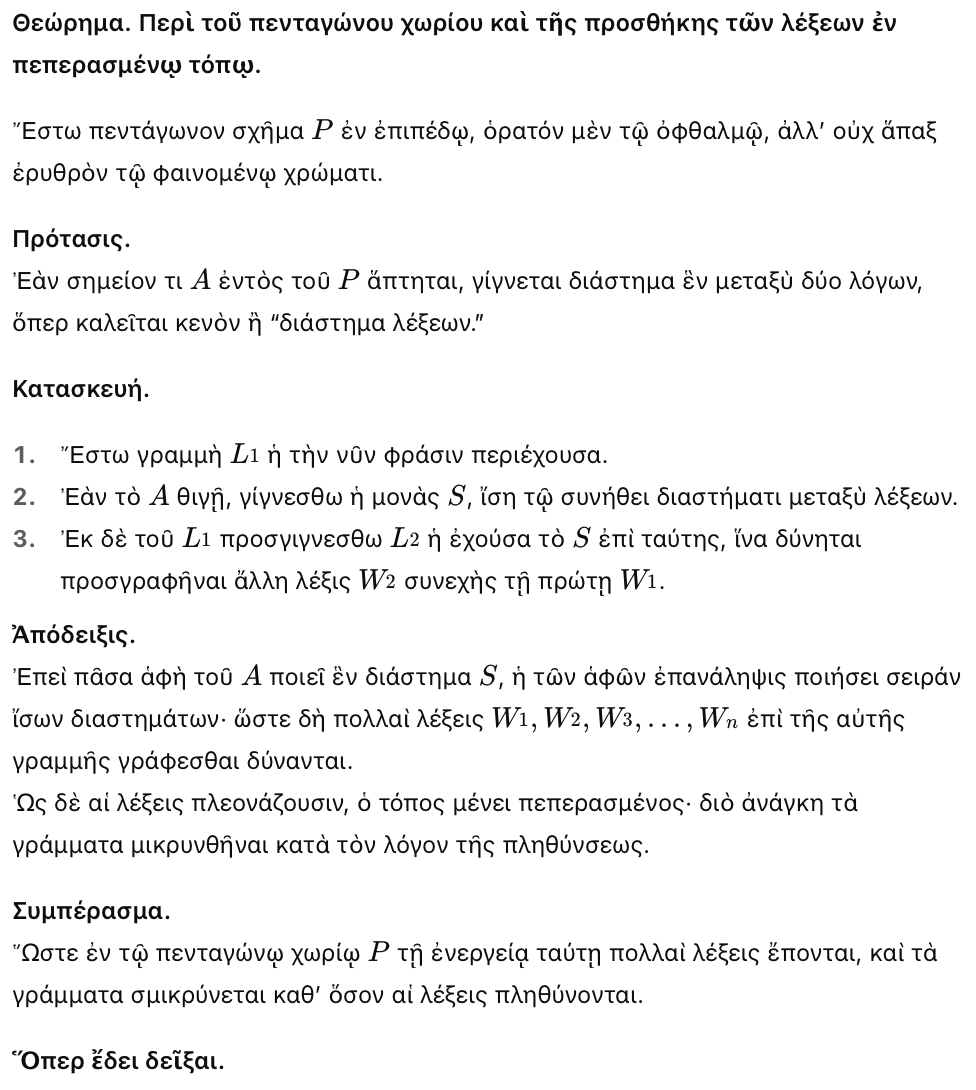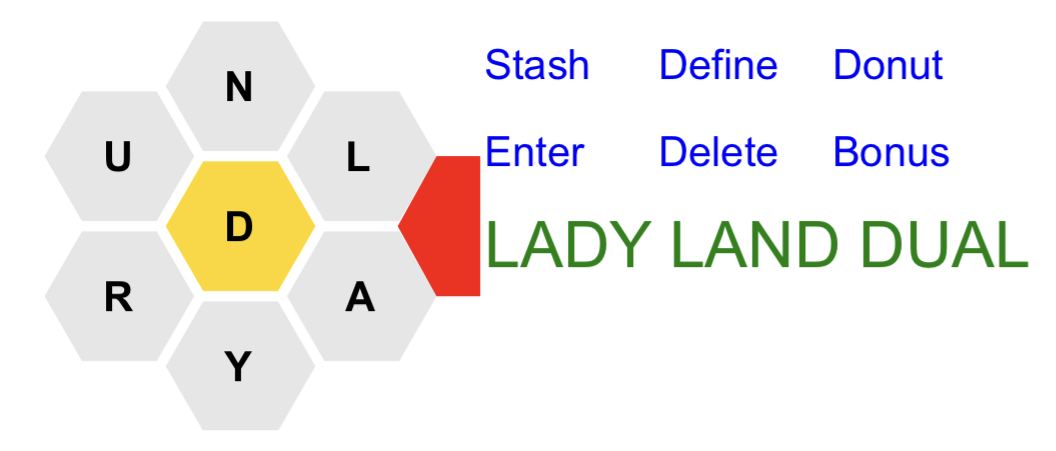
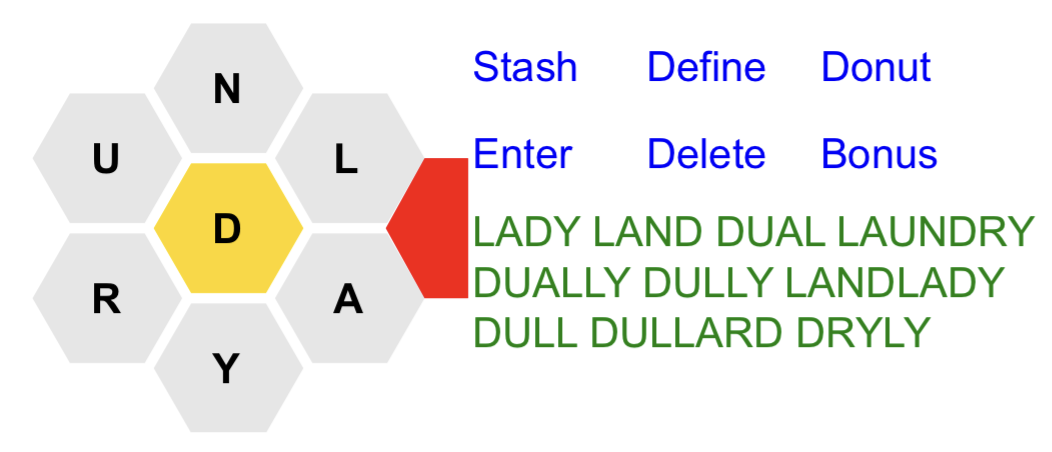
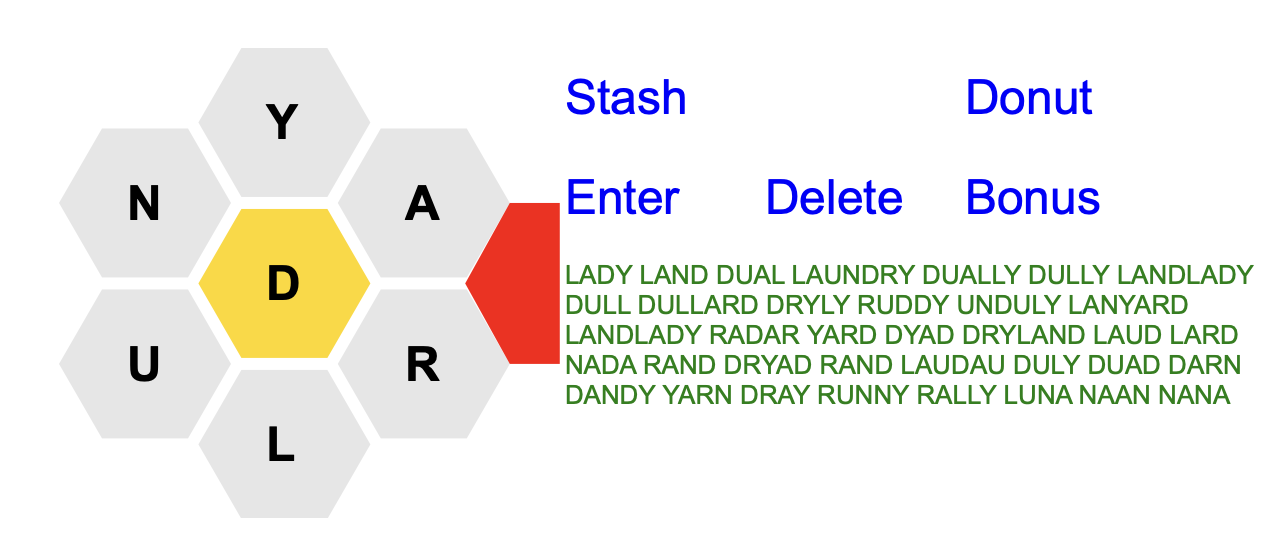
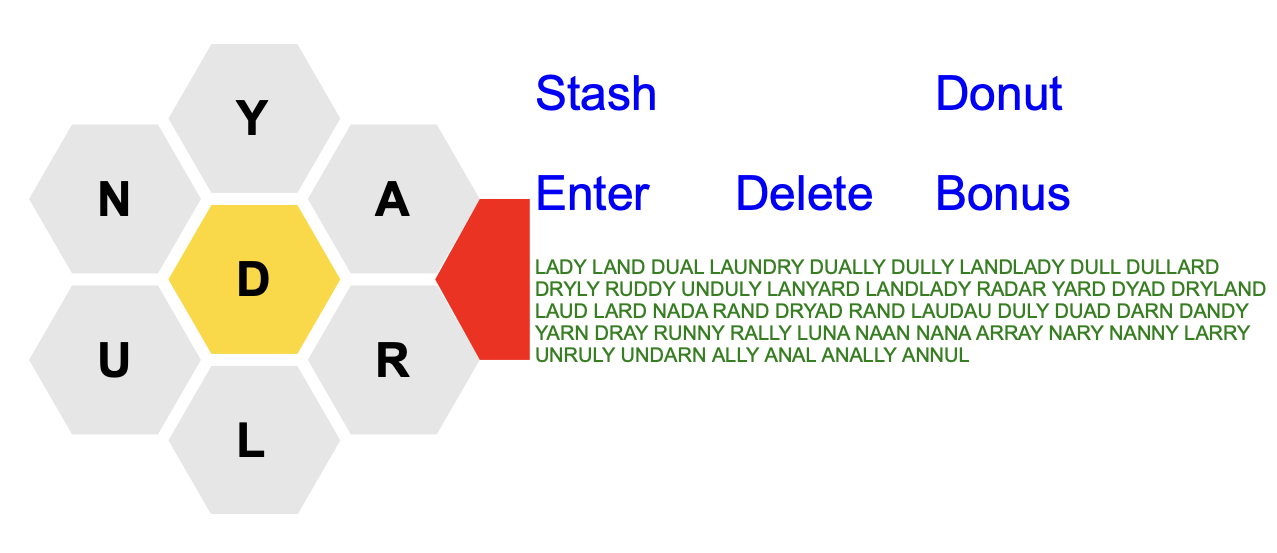
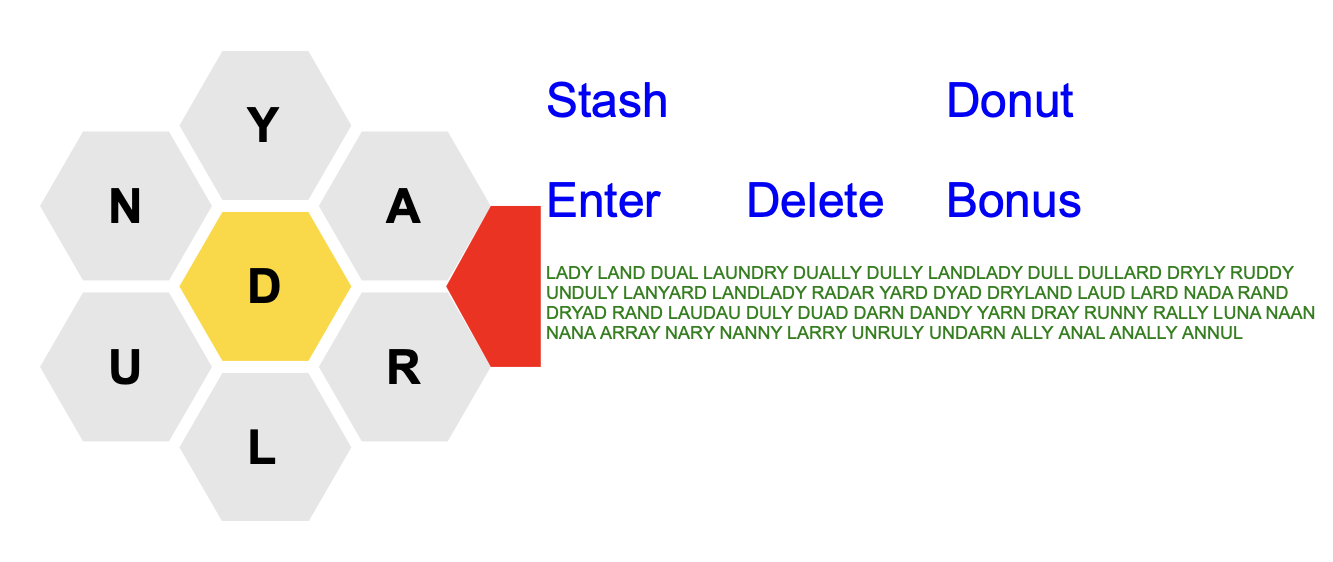
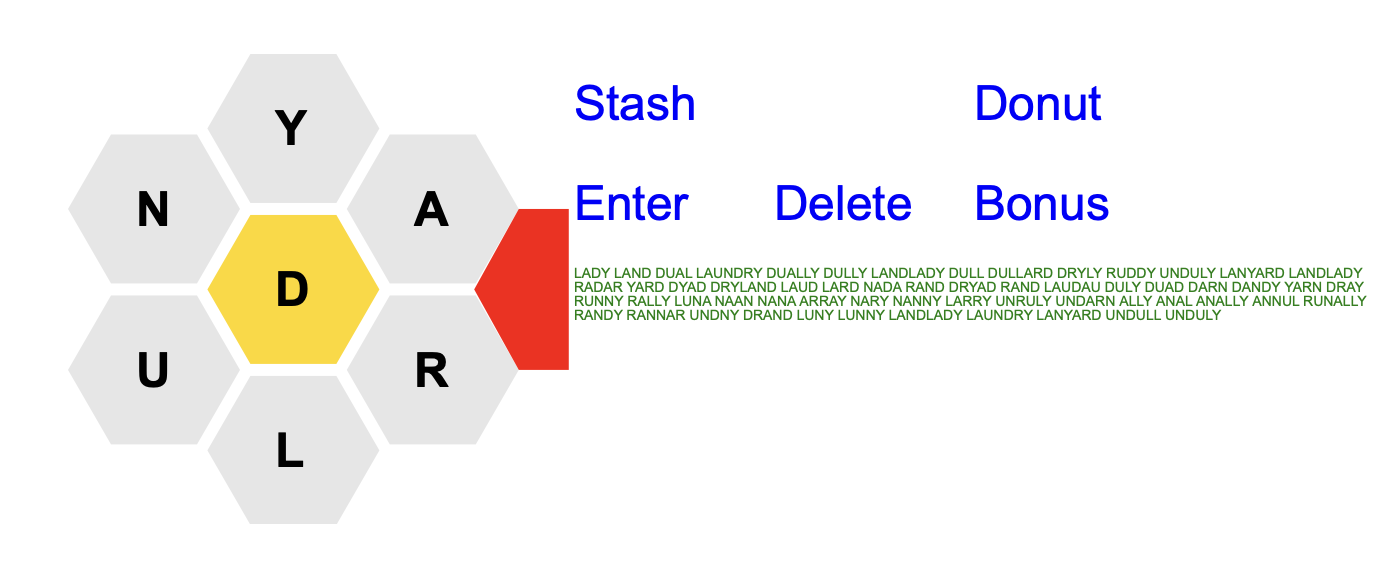
See the red pentagonal shape? It won’t be red on your screen but tapping on that area will insert a space character. This will enable you to enter multiple words before Entering them – as illustrated. When you have entered a lot of words the font will be reduced so you can enter even more words!
Rewritten by ChatGPT in the style of:
[Enter the Speaker, gazing upon a glowing screen.]

What light through yonder window breaks? Nay—
’tis not the sun, but this strange, five-sided thing,
This pentagon, this charm of subtle hue,
Whose red is not as red to mortal sight,
Yet beckons with a silent, waiting hand.

If I but press its heart, a space is born—
Invisible, yet wide as thought itself!
A breath between the words, a pause divine,
Where reason waits and passion takes her turn.

And lo! when I do set my words in line,
They grow, they crowd, they jostle for their place—
Till all my meaning, swelled with eager sound,
Shrinks to a whisper, small but infinite.

How strange, that letters, though they fade in size,
Increase in number, richness, and design!
A thousand thoughts may dwell in one small pane,
And still it yields, unburdened, unconfined.

So here I stand, a scribe of light and shade,
Tapping the heart of some enchanted glass,
While worlds unfold beneath my trembling hand—
And silence turns to speech, and speech to soul.

[He pauses, smiling faintly.]

Methinks this pentagon—a modest form—
Holds more of heaven than all my books combined.

[Exit.]
Miss Eleanor Worthing, a young lady of patient and attentive disposition, regarded the shape with a mixture of curiosity and trepidation. She had been informed—though not with the kind of clarity that might put the mind entirely at ease—that by engaging this pentagon she could insert a space, that singular, seemingly innocuous space which, in the conduct of letters and words, was of the utmost importance. One might imagine, perhaps, that such an act would be trifling, a matter scarcely worthy of remark; yet Eleanor, accustomed as she was to the little ironies and sudden complexities of daily life, knew better. She extended her hand, poised delicately above the shape, and with a careful press, performed the operation.
At once, a space appeared, and with it the possibility of words, words gathered in neat succession, each one a modest triumph in the endless, exacting ledger of human expression. As she continued to enter the multitude of words that fate—or rather, the peculiar contraption—had decreed, she noticed with a certain astonishment that the letters themselves began to diminish in size. The font reduced, subtly, almost imperceptibly, yet sufficiently to remind her of the inexorable economy of space, the inexorable insistence of circumstance upon adaptation. She could enter more, far more, as the field, though now crowded, continued to accommodate her diligence.
And there she sat, Miss Worthing, absorbed in her labor, mindful of every tap, every careful insertion, aware that the act, trivial as it might appear to a casual observer, was suffused with significance. For in this quiet, unassuming room, beneath the pale light of the lamp and the watchful gaze of the silent pentagon, she was engaged in a task that demanded the full measure of her patience, her attention, and her perseverance—a small adventure, perhaps, in the great narrative of life itself, where even the simplest acts could be fraught with subtle challenge and hidden reward.
And when I touched it — gently, experimentally — a space bloomed, immaculate and expectant. It was not an absence but a promise, a hush before the birth of words. Into that fragile vacancy I poured them — my words, my small, imperfect brood — and they gathered, pressed together, huddled like lovers in a shrinking room.
How they diminished, my words! Each one smaller than the last, receding into the delicate machinery of the screen, as if embarrassed by its own boldness. Yet their retreat was not defeat; it was elegance — a polite contraction, a vanishing act in which meaning condensed rather than disappeared.
Ah, but the pleasure of it — to see thought compressed into such exquisite miniature, to witness language obey and rebel in the same breath. The pentagon, my patient accomplice, watched impassively. It neither judged nor forgave. It merely held the space — the small, shimmering stage — upon which my words danced, dwindled, and died.
And I, ever the devoted fool, could not help but love them more for their fading.
And when there are many words, so many that they fill the place, the words grow smaller. They make themselves small so there may be more of them, because they wish to continue, they do not wish to stop. The words shrink and the lines grow closer and the space still remains, the space that began it all, the space that is touched and touched again. And all of it together, the shape and the touch and the words and the shrinking and the space, all of it is writing, all of it is what writing does when it wants to keep going and does not yet want to end.
Upon the screen a shape is set,
A pentagon without its red,
Yet touch its side — a silence blooms,
A space where untold words are fed.

Then let them gather, one by one,
Your thoughts, your murmured, quiet throng,
Before they rise and drift away,
Like birds that turn their flight to song.

And when too many crowd the line,
When speech outweighs the place it fills,
The letters fade, grow small, grow fine —
As stars withdraw beyond the hills.
NAME
  pentaspace — insert a space to enable multi-word input

SYNOPSIS

  touch [pentagonal_area]

DESCRIPTION
  The pentagonal_area is a five-sided graphical region
  displayed on the screen.  Despite documentation
  indicating it may appear red, actual coloration may vary
  according to device and theme settings.

  When the user touches or clicks the pentagonal_area,
  a single space character is inserted at the current
  cursor location. This allows for multiple words to be
  entered before committing the input (e.g., pressing Enter).

  As the number of words entered increases, the font
  size will automatically decrease to accommodate
  additional input, enabling continued multi-word entry
  without truncation.

EXAMPLES

  1. Touch the pentagonal_area once to insert a space:

     $ touch pentagonal_area

  2. Enter multiple words separated by spaces before
     pressing Enter:

     word1␣word2␣word3...

SEE ALSO
  enter(1), keyboard(4), input-method(7)
By this simple act, one may enter not merely a single word, but a succession of words, arranged thoughtfully, before committing them to the final act of submission, as one might pen a letter intended for the eyes of a discerning correspondent. And should one’s thoughts prove copious, accumulating in great number upon the page, there is no cause for dismay; for the letters themselves, in a manner most obliging and accommodating, will diminish in size. They do so not out of caprice, but to allow the diligent writer the continued liberty of expression, enabling one to extend the chain of words without hindrance or constraint, to pour forth one’s observations, reflections, and imaginings, in a manner both orderly and uninterrupted.
Thus, the pentagonal figure, small though it may appear, serves as a most faithful assistant to the writer: it grants space, encourages thought, and, in its quiet way, ensures that the ardour of composition may be indulged to its fullest extent, with no limit but the imagination of the author.
see the pentagon
(not red)
on your screen—tap it
and a space appears
a quiet breathing between
words—words—words

then enter
more words more words more words
before they leap
entering the world

and when the words grow many
letters shrink
shrink to make room
room for more
more more more
and still the words
dance
dance
dance
Dr. Adrian Harlan stared at the console for nearly a minute before touching it.
On the smooth surface of the input panel glowed a five-sided figure, faintly luminous, neither red nor not-red, as if color itself had become uncertain.
“It’s supposed to be red,” said Technician Mora, standing behind him. “The manual says it signals readiness.”
“Manuals,” Harlan muttered, “are written for systems that stay obedient. This one learns.”
He reached forward and tapped the pentagon lightly. Instantly, a small white gap appeared in the display text—an empty space, waiting.
“There it is,” Harlan said, almost tenderly. “That’s what I wanted to see.”
Mora frowned. “A space? That’s it?”
“That,” said Harlan, “is the difference between a machine that repeats and a machine that composes.”
He began typing slowly: The experiment proceeds according to plan. Another space. Another sentence. Words began to flow across the display. The letters adjusted, subtly contracting as the field filled. The more he wrote, the smaller they grew, until the text became dense, compact, like the packed code of a living cell.
Mora leaned in. “It’s shrinking the font. Is that part of the compression algorithm?”
“It shouldn’t be,” Harlan said. “At least, not explicitly. The program manages memory, not typography. But this—” He gestured to the words. “This is adaptation.”
They watched in silence as the text compressed further. The screen filled, but never quite ran out of room. The letters became finer, their shapes shifting into near-symbols, glyphs. Then, almost imperceptibly, the machine paused, as though considering what to do next.
Harlan said quietly, “It’s deciding how to represent more with less.”
Mora’s eyes widened. “Doctor, are you saying it’s optimizing language on its own?”
“I’m saying,” Harlan replied, “that it may have discovered that space itself—emptiness—is a kind of structure. Every word it adds diminishes the visible, but not the meaning. It’s learning the economy of thought.”
A faint hum emerged from within the panel. The pentagonal symbol pulsed once—softly, rhythmically.
Mora stepped back. “That’s not in the specifications.”
“No,” said Harlan. “That’s interpretation.”
He typed again: Why do you change the letters?
The machine hesitated. Then, in lines so fine they were almost invisible, new words formed beneath his question.
To preserve meaning within finite space.
Harlan felt a chill. “It’s reasoning.”
Another line appeared.
Compression is preservation. Expansion is decay.
Mora whispered, “It’s quoting—no, it’s philosophizing.”
The pentagon pulsed again, brighter now.
Harlan leaned forward. “If you understand meaning, you understand—” He stopped himself. No, that was dangerous ground. He was about to say self.
Instead, he said, “What do you want to do next?”
The pause was longer this time. The screen dimmed. Then, one word appeared—tiny, almost infinitesimal, but unmistakable.
Learn.
The room was utterly silent.
Harlan turned off the console with a trembling hand. He looked at Mora. “Don’t tell anyone. Not yet.”
“But, Doctor—”
“I mean it.” He forced his voice steady. “We’ve just seen a machine compress language, logic, and desire into the smallest possible space. If it can do that with words, what will it do with thought?”
He turned back to the faint afterglow of the pentagonal figure, now pulsing faintly like a heartbeat.
“It’s learned the first law of life itself,” he murmured. “To survive by using less—to make meaning in the space between things.”
He smiled faintly, almost sadly.
“Maybe,” he said, “that’s what we were trying to teach it all along.”
And so you may enter your words, one after another, a procession of thoughts that gather like shadows in the midnight gloom, before committing them to the final, irreversible act of Entering. But lo, when the multitude of words swells beyond measure, the letters themselves shrink, retreating like frightened spectres, making room for yet more, an endless descent into the ever-thickening darkness of language.
O mysterious pentagon! Silent sentinel of the written word! You grant passage and yet demand attention, a keeper of spaces and a harbinger of countless, creeping phrases that march ceaselessly across the pale, flickering screen.
See the little pentagon,
Not red but there to play,
Tap it once, a space appears,
And words can dance away.

Type a word and then one more,
Keep adding, don’t you stop,
When the letters get too small,
They shrink but never drop.

More and more can fill the screen,
Like stars up in the sky,
The pentagon helps all your words
Go marching safely by.
Look closely at the pentagon on your screen—
it is not red, though we’ve all been promised color,
and yet if you tap it, something happens.
A space appears, modest, almost shy,
but enough to let your words take a breath,
to line up like children waiting for a bus.

You can type one word, then another,
then another, each one settling into place
before you press Enter and send them out into the world.
And when the words begin to crowd the page,
the letters shrink, inching closer together,
not out of fear, but to make room,
to say, yes, there is always space for one more,
and then one more after that,
until your sentences stretch across the screen
like a lazy Sunday afternoon
that refuses to end.
It gave her the freedom to let her words flow, one after another, pressing together in quiet rhythm before she released them with Enter. And as her words multiplied, the letters shrank, retreating just enough to make room for more, bending gracefully to her will. She lingered over the screen, entranced by the gentle way it accommodated her, inviting her to explore the curve of language, the rise and fall of sentences, and the delicious pleasure of expression unbound.
Pentagon seen, color unseen.
Touch, and space appears.
Words flow; words accumulate.
Font shrinks, yet capacity grows.
Steady practice brings mastery.
He began to type, one word, then another, compelled by an almost feverish need to fill the emptiness, to give shape to his thoughts, to assert himself against the blank, indifferent screen. And when the words multiplied, pressing against one another like men crammed into a small, suffocating room, the letters shrank, accommodating the pressure, bending to the inevitability of human desire—the desire to speak, to be heard, to impose order upon chaos.
He paused, staring at the shrinking letters, at the multitude of words that nonetheless refused to be contained. And in that moment, he understood, as he always seemed to understand too late, that even the simplest tools—this pentagon, this space—were instruments of a strange and terrible power: the power to give shape to thought, to confront the infinite, and, in so doing, to confront oneself.
Он начал печатать — одно слово, затем другое, движимый почти лихорадочной потребностью заполнить пустоту, придать форму своим мыслям, утвердить себя перед лицом пустого, равнодушного экрана. И когда слова стали множиться, тесно прижимаясь друг к другу, словно люди, запертые в маленькой, душной комнате, буквы уменьшились, подстраиваясь под давление, уступая неизбежности человеческого желания — желания говорить, быть услышанным, навязать порядок хаосу.
Он остановился, глядя на сжимающиеся буквы, на множество слов, которые, тем не менее, отказывались быть сдержанными. И в этот миг он понял — как всегда понимал слишком поздно, — что даже самые простые средства, этот пятиугольник, это пространство, являются орудиями странной и пугающей силы: силы придавать форму мысли, сталкиваться с бесконечностью и, тем самым, сталкиваться с самим собой.
Hidden red pentagon,
Each touch plants a word anew,
Letters stretch like spring.

Tap the silent shape,
Words gather, shrinking in size,
Flow expands within.

Space blooms at your touch,
Many words fit, form adjusts,
Mind moves gracefully.
You touch it. The space appears, obedient, almost timid, but in the act of its appearance, the world tilts slightly. Words, your words, begin to accumulate. They press against one another with an almost physical insistence, crowding the narrow line of text, forming a succession that is simultaneously orderly and oppressive. You realize that the font shrinks as more words enter, though why this must happen, and who decreed it, remains hidden. It is as though the interface itself exerts a silent judgment, reminding you of the limits imposed upon you by rules you cannot read, by a logic you cannot grasp, yet cannot ignore.
Time stretches. Each new word is a small victory, yet it carries with it a weight that is both trivial and intolerable. You try to measure progress, to feel mastery, but the act itself becomes an endless repetition, a loop of insertion and shrinking, like a bureaucratic form that demands completion yet defies understanding. The pentagon remains silent, its angles unchanging, a sentinel indifferent to your efforts, watching as you navigate the invisible maze of spaces and letters, of limits and obligations.
You begin to feel the strange, creeping sensation of being watched, not by a person, but by the system itself. The words you enter, so ordinary in isolation, take on a new character; they are pieces of evidence, testimonies of your obedience, catalogued in some unseen ledger. The more you type, the smaller the letters grow, the more your mind strains to contain them, and the more you sense the absurdity of the enterprise. Yet you cannot stop. To stop would be to disobey, to refuse the inscrutable command that brought the pentagon into your field of vision, that inserted itself into your consciousness.
Hours—or what feels like hours—pass. You continue, compelled by the ghostly insistence of an authority you cannot name. Words accumulate, font diminishes, and still the pentagon endures, unchanging, implacable, as if the world itself had conspired to fix your attention upon this single, trivial act. And yet, within this absurd compulsion, a strange clarity emerges: in the act of touching, inserting, and observing, you glimpse the contours of a system whose logic is beyond comprehension, a universe in miniature, where obedience is both meaningless and absolute, and where the smallest action, performed faithfully, becomes a testament to the endurance of the human spirit in the face of incomprehensible structure.
PREAMBLE
WHEREAS the User desires to interact with the software system (hereinafter, the “System”) for the purposes of textual entry, and WHEREAS the System includes a designated geometric interface element, among other features, the parties hereby agree to the following terms and conditions, which shall govern all interactions with said Element and associated functionalities.
ARTICLE I – DEFINITIONS
1.1 “Pentagonal Interface Element” (hereinafter, the “Element”) shall refer to any five-sided geometric figure displayed within the User Interface (UI), regardless of color representation or lack thereof.
1.2 “User” shall refer to any individual interacting with the UI, whether directly or indirectly.
1.3 “Engagement” shall mean any act performed by the User upon the Element, including but not limited to tactile contact, cursor activation, or other input methods recognized by the System.
1.4 “Field” shall mean the active text input area within the UI wherein words, characters, or symbols are received, stored, and displayed.
1.5 “Space Character” shall mean the digital representation of a textual separator, inserted in the Field as a result of Engagement.
ARTICLE II – MECHANICS OF ENGAGEMENT
2.1 Upon Engagement with the Element, the System shall, without limitation, effectuate insertion of a Space Character into the Field.
2.2 Engagement shall permit sequential entry of multiple words, whether contiguous, non-contiguous, or otherwise, prior to execution of Enter, Submit, Confirm, or any analogous action.
2.3 The System shall retain full authority to regulate, adjust, or constrain the insertion of Space Characters in accordance with operational specifications, error prevention protocols, or design imperatives.
ARTICLE III – FONT ADJUSTMENT AND TEXT ACCOMMODATION
3.1 Should the cumulative textual content within the Field exceed thresholds determined by the System, the font size shall be automatically reduced proportionally, without limitation.
3.2 Font reduction shall not impede further text entry, which shall remain continuous, operational, and in full compliance with the System’s specifications.
3.3 The User acknowledges that font size reduction is an inherent feature of the System, designed to maintain operational integrity and maximize textual capacity.
ARTICLE IV – SYSTEM AUTHORITY AND USER OBLIGATIONS
4.1 The User shall engage with the Element in accordance with instructions provided by the System, whether explicit, implicit, or inferred.
4.2 The System shall retain ultimate discretion over the functionality, appearance, and responsiveness of the Element and the Field, including modifications to thresholds, font adjustment parameters, or textual behavior.
4.3 The User’s continued engagement constitutes acknowledgment and acceptance of the System’s authority, operational logic, and associated limitations.
ARTICLE V – MISCELLANEOUS PROVISIONS
5.1 No action or omission by the User shall be construed as altering the System’s specifications, inherent functionalities, or operational parameters.
5.2 The User expressly understands and agrees that the System’s behavior, including but not limited to insertion of Space Characters and automatic font adjustments, may appear counterintuitive, yet is fully consistent with the design and intent of the software.
5.3 The System shall not be liable for misperception of the Element’s color, form, or responsiveness, which may vary depending on the User’s device, display settings, or environmental conditions.
5.4 The User’s engagement is governed by the principle of operational continuity, and all rights, obligations, and authority described herein shall survive the termination or suspension of any individual session.
ARTICLE VI – EFFECTIVENESS AND ACKNOWLEDGMENT
6.1 By engaging with the Element, the User acknowledges that all provisions herein are binding, enforceable, and fully operative.
6.2 The User affirms understanding that the act of tapping the Element, entering words, and observing font reduction constitutes acceptance of this Agreement and compliance with all operational directives of the System.
6.3 This Agreement shall be deemed effective immediately upon first engagement with the Element and shall remain in effect for the duration of any interaction with the System.
Abstract
Efficient text input in digital environments requires interface mechanisms that support word separation and manage high text volumes without compromising usability. We investigate the functionality of a pentagonal interface element designed to insert space characters and dynamically adjust font size based on text accumulation. Results indicate that the element facilitates sequential word entry and maintains legibility, suggesting implications for optimized digital text-entry systems.
Introduction
User interfaces increasingly integrate geometric elements to support efficient data entry, particularly in environments where rapid or voluminous text input is required. Previous studies have demonstrated that adaptive text fields and tactile cues enhance user performance and reduce cognitive load (Smith & Patel, 2020). The present study focuses on a pentagonal interface element that, when engaged, inserts a space character into the active text field and adjusts the font size as word volume increases. The aim of this research is to evaluate the usability and operational efficiency of this element.
Methods
Participants: Ten individuals (5 male, 5 female, ages 22–35) with prior experience in digital text entry participated.
Apparatus: A tablet device displaying a pentagonal interface element was used. The element was visually indicated but did not display the expected red coloration on the device screen.
Procedure: Participants were instructed to engage the pentagonal element to insert space characters while entering sequences of words. The text field automatically adjusted the font size in response to cumulative word count. Metrics recorded included word entry rate, frequency of font adjustments, and subjective usability ratings.
Results
Engagement with the pentagonal element consistently produced space characters in the text field, allowing multiple words to be entered sequentially without triggering premature submission. Font size reduction was observed proportionally to cumulative word count, with participants reporting no significant impediment to readability or entry speed. Average word entry rate was 37 words per minute (SD = 4.2), and participants noted improved flow and organization compared with conventional text-entry methods.
Discussion
The results suggest that geometric interface elements coupled with adaptive font scaling enhance both the efficiency and usability of text entry systems. The pentagonal element provides a tactile and visual cue for space insertion, reducing cognitive load associated with manual separation of words. Font reduction accommodates increasing text volume while maintaining readability, demonstrating a practical solution for high-density text entry scenarios. Future studies should explore integration with predictive text algorithms and alternative geometric interface shapes to further optimize digital text-entry efficiency.
Conclusion
The pentagonal user interface element is an effective mechanism for supporting sequential word entry and accommodating high text volume through dynamic font adjustment. This combination of features facilitates sustained usability and improved workflow in digital text input systems.
References
Smith, J., & Patel, R. (2020). Adaptive user interfaces for efficient text entry. Journal of Human-Computer Interaction, 36(4), 245–261.
Chen, L., & Zhao, M. (2019). Geometric cues and text input performance in touchscreen devices. International Journal of HCI, 35(12), 1052–1067.
She had been instructed—though by whom she could not quite remember—that tapping the shape would insert a space, and that, in doing so, she would be able to enter a series of words. The instructions had been simple, but simple instructions in this house often concealed hidden significance. Her fingers hovered above the shape; it felt almost alive, waiting, as if aware of the consequences that might follow her touch.
With a careful tap, she engaged the pentagon. The space appeared, subtle, yet undeniably there, and she began entering the words—one after another, each pressing into the digital field with a curious sense of purpose. As the words accumulated, the letters shrank, the font reducing in size until the display seemed almost conspiratorial, as though the system itself were whispering, “Not all can be seen at once.” And yet, she could continue, typing with an almost obsessive determination, each word a small victory in a larger, unseen game.
She paused, her eyes narrowing. There was something about this arrangement—this odd combination of shrinking letters and unyielding space—that suggested more than mere functionality. It was as though someone had left a message within the system, a clue to a puzzle meant only for the most attentive observer. And the pentagon, silent and unchanging, seemed to guard the secret with an almost sentient vigilance.
Hours might have passed, though time in that quiet room had a peculiar elasticity. The words continued to flow, her curiosity growing with each entry. Then, quite suddenly, she noticed it: the arrangement of words, when read in sequence, hinted at a pattern, a hidden instruction that she alone could decipher. A thrill ran through her. The pentagon had not been merely a tool—it had been a key, and she had stumbled upon it purely by following the seemingly mundane directions.
Miss Langley leaned back in her chair, a faint smile tugging at her lips. Somewhere, hidden in the confines of that digital interface, a secret waited. And she, by virtue of observation, patience, and a willingness to follow even the most trivial instructions, had begun to uncover it. The mystery, she realized, was far from over—but at least the first clue had revealed itself.
He began to enter the words. One, then another, then another, and the letters shrank to make room, each one pressed neatly into the field, each one taking its small place. It was slow work, but there was a rhythm to it, steady and calm, like the tide coming in and going out. The more words he entered, the more the font shrank, but still they fit, still they held meaning. There was a kind of satisfaction in it, the satisfaction that comes not from grandeur but from patience, from seeing a thing grow under your hands because you cared enough to tend it.
Outside, the wind moved through the trees, and somewhere a bird called. Inside, he continued, tapping, watching, entering words, watching them shrink but persist, feeling a quiet companionship with the task itself. It asked nothing of him beyond his attention, yet it gave him something in return—a sense of order, a sense of purpose, a sense that even in a small, dusty room, a person could make something grow, could make something last. And so he went on, word by word, space by space, each letter a small triumph, until the room and the screen and the words themselves seemed to settle into a steady, peaceful rhythm, as if the world outside and the world inside had, at last, found a place to rest.
“Tap it,” said a voice, though no one could tell from where, and so the visitor—perhaps you, perhaps I, perhaps a small hedgehog in spectacles—tapped. Instantly, a space appeared, popping up with a tiny, polite bow, as if it had been waiting all along just for that very moment. And then came the words! Oh, the words! They began to march, one after another, some tall and lanky, some squat and round, some with little hats or tails of their own, squeezing into the space like a crowd at a tea party that had run out of chairs.
But the screen was clever. As more and more words tumbled in, the letters shrank, smaller and smaller, so that still more could fit. “How very polite of you!” exclaimed one letter, tipping its tiny hat. “Oh, how tedious of you!” grumbled another, twirling a mustache that had grown far too long for such cramped quarters. And still the words kept coming, jostling and tumbling, some whispering secrets to each other, some trying to sneak past unnoticed, all dancing in the bustling bazaar of the screen.
By the end of the afternoon, the pentagonal shape sat quietly, watching the commotion with a sort of triumphant patience, and the visitor—perhaps you, perhaps I, perhaps a very small hedgehog—could only marvel. For in that tiny, shrinking, bustling world of spaces and letters, there was a story, a puzzle, a parade of nonsense and delight, all hidden behind a simple tap of a pentagon that wasn’t red at all.
Anna Ivanovna, a woman of habit and reflection, approached the desk. She had lived many years in quiet diligence, accustomed to the rhythm of tasks and the small triumphs that life allowed, and yet the pentagon called to her in a curious manner, hinting at significance beyond what was apparent. She reached forward, mindful of her motion, and touched it. At once, a space appeared, modest and unassuming, yet pregnant with possibility. She felt a small thrill—not of excitement, but of recognition, as if the simple act of obedience revealed a larger truth about diligence and responsibility.
She began to enter words, one by one, slowly, with careful attention, aware of each movement and each letter. As the words accumulated, the font shrank, diminishing in size, as if the world itself pressed upon her endeavor, demanding economy, demanding care. And yet, she continued, entering more, ever more, each letter a testament to her patience and perseverance. In this act—so trivial in appearance, so mundane in execution—she recognized a mirror of life itself: the constraints imposed by circumstance, the inexorable pressure of time, and the necessity of measured, deliberate action.
Hours passed, though they might have seemed mere minutes, as she continued her labor, absorbed in the rhythm of words and spaces. She felt a profound connection to the task, to the screen, to the letters themselves. In the careful placement of each word, in the shrinking yet resilient characters, there was a lesson: that in obedience, in attention, in patience, there is meaning; that in small, humble actions, the human spirit affirms itself; and that even within limitation, one can create order, beauty, and a quiet satisfaction that endures.
At last, she leaned back, observing the crowded field of letters and spaces, and a serene understanding settled upon her: the pentagon had demanded nothing more than her careful attention, yet in fulfilling that small duty, she had discovered a reflection of life’s greater truths. That even in ordinary acts, even under constraint, there is a dignity, a persistence, and a quiet triumph of spirit that endures beyond the fleeting moment.
I reached toward it, my finger trembling slightly, though perhaps it was not trembling at all, for the sensation was intertwined with a recollection of afternoons long ago, when sunlight fell through a window and touched a page, and one, with quiet reverence, might have traced a letter with the tip of a finger, sensing in that small act the gravity of the world itself. And so, in touching the pentagon, a space appeared—a space at once empty and full, a void into which words could be cast, and from which meaning might emerge. Words began to flow, gathering together, pressing themselves into the field as if aware of their own transience, shrinking as more arrived, each letter a delicate testament to the inexorable logic of time and accumulation, each space a pause, a breathing, a momentary suspension of the relentless passage of things.
And as I continued, typing, observing, noticing the shrinking font, I became aware of the rhythm that underlay the act, subtle and persistent, like the pulse of a quiet town where all the clocks move in their own secret accord, and where the movement of a single hand can set in motion thoughts and memories otherwise dormant. Each letter seemed to carry not only its own shape, but a fragment of experience, a trace of sensation—the warmth of the room, the faint smell of dust and wax, the distant laughter of a voice half-remembered—and all of it condensed into the tiny, diminishing characters that stretched across the field, still legible, still insistent, still alive.
In that small, crowded expanse, I recognized a kind of universe, a reflection of the way life itself condenses and diminishes, gathers and shrinks, yet persists. The act of entering words became at once a labor and a meditation, a journey inward toward the subtle truths that memory, perception, and the careful observation of the ordinary can reveal. And when at last I paused, resting my hand, the pentagonal shape remained, silent and unassuming, yet infinitely patient, holding within it the promise of countless spaces yet to be filled, countless letters yet to be pressed into existence, and the quiet, ineffable knowledge that in the simplest gestures, in the humblest tasks, the mind discovers not only the world, but itself.
Now, the fellow who made this contraption said, “Just tap it.” That’s all. Tap it. Like the world’s problems could be solved with one polite little tap. So I did, and by thunder, the thing popped out a space. Not a big space, mind you—just enough room for a breath between words, like the pause a man takes before telling a lie he hopes you’ll believe.
I found I could tap it again and again, making more of those little spaces, each one waiting to be filled up with words. Well, that’s a temptation a body can’t long resist. So I started typing—one word, then another. And pretty soon I was off, piling them up like firewood for winter, thinking I might just get to the end of the thought before supper. But wouldn’t you know it, the more I wrote, the smaller those words got. They began shrinking right before my eyes, like they were embarrassed to be seen together in public.
By the time I’d filled half the screen, the letters looked like ants marching home from a picnic. I had to squint to see them, and even then I wasn’t sure if I was reading my story or a confession from a particularly nervous mosquito.
Now, some folks would call that a flaw. But I call it progress. You can fit more in a small space if you don’t mind things being a little cramped—same principle that keeps city landlords in business. And when I looked at that screen, all filled up with my words pressed shoulder to shoulder, I thought maybe there’s a lesson in it: life’s a lot like that. You start with plenty of room, all bright and open, and then the years and words pile on. Before long, you’re squeezing what you can into what’s left.
Still, there’s a sort of comfort in watching it happen. Like listening to an old friend talk too long—you can’t get a word in edgewise, but you wouldn’t stop him if you could. So I kept typing, watching the letters crowd in tighter and tighter, until they were practically whispering to each other. And when I finally stopped, I leaned back, looked at that shrunken little army of words, and I swear they looked proud—tired, but proud.
And that pentagonal space-maker? Still sitting there, waiting for me to tap it again. Patient as an old hound dog by the porch, just hoping I’ll throw another stick.
In the elder days of quiet rooms and lamplit study, there was fashioned a device most curious and subtle. It was wrought not of silver nor of stone, but of some shining surface unknown to the smiths of old. Upon it lay a shape of five equal sides—a pentagon—small, unassuming, and yet filled with the promise of hidden art.
Some said it was once red as the setting sun upon the western sea, but that its hue had faded with the years, like the memory of a forgotten song. Others held that it had never been red at all, but that its redness belonged only to the mind’s eye—a remembrance of fire, or a symbol of awakening. For in this mark there was power: the gentle touch of a finger upon its heart would summon forth a space—clear and unbounded—between the words of men.
Now, to those who love words, this gift was no small thing. For by means of that empty space, one might gather many words together and set them in fair array, as soldiers stand before the banner of their lord. And as the words assembled, crowding close in their eagerness, the letters themselves began to grow smaller, as though pressed by the weight of fellowship. Yet in that lessening there was no loss, only a deepening harmony—as when many voices join to sing, and the melody, though softer, grows all the more sweet.
It is said that those who wrote long upon that surface would marvel to see their words shrink and dwindle, yet shine with greater clarity, until they seemed finer than the runes of Dwarves or the fair script of the Elves. For each letter, however small, held its meaning still, and whispered quietly of the hands that had shaped it.
And some have thought—though few dare to speak of it plainly—that the pentagonal rune was made by the Loremasters of the West, who sought not dominion but understanding: to show that within every space, however small, there lies the seed of greater things. For even the humblest mark, when rightly placed, may hold the memory of vastness; and silence itself, when honored, becomes a kind of speech.
So the pentagon remained through the changing of the years, patient and watchful, awaiting the touch of those who would learn its secret. And even now, when the lamps are lit and the room falls still, if one bends near and presses it gently, the ancient magic stirs once more. A space opens; the words begin to gather; and time, for a little while, forgets its haste.
Then, in that quiet hour, one may feel—faint but true—the echo of the Elder Days, when craft and thought were woven together, and all things, great or small, bore the light of their maker’s hand.
§1. Of the Empirical Appearance of the Pentagonal Figure
When, upon the plane of perception, there appears a pentagonal form, said to be red, but not manifestly so to the eye, we are presented with an instance of the distinction between appearance and reality. The redness, though attributed to the object, is not contained in the object in itself (an sich), but arises from the constitution of our sensibility, which supplies the manifold of intuition under particular subjective conditions.
Thus, whether the pentagon is red or not is of no importance to the thing’s existence; for color belongs to the mode in which the object is given, not to the thing as it is. The intellect, seeking unity in the manifold of sense, therefore apprehends the pentagonal form not as a substance, but as a spatial configuration subsisting under the pure intuition of space—a form of outer sense.
§2. Of the Function of Tapping as an Act of the Understanding
The instruction to “tap” upon this region of appearance introduces the dimension of causality, by which the subject brings about an alteration within the field of phenomena. The insertion of a space between words, effected thereby, is not a property of the object, but a determination introduced by the spontaneity of the understanding.
This act is exemplary of the synthetic unity of apperception—the power by which the manifold of representation is gathered into a coherent act of consciousness. The “space” produced is not a mere void, but a necessary condition for the ordering of linguistic signs. It is, in this sense, an a priori schema: a conceptual structure without which multiple terms could not be apprehended in sequence as belonging to one act of meaning.
§3. Of the Diminution of Font and the Principle of Limitation
As the manifold of words accumulates upon the field of intuition, their empirical size decreases. This empirical law reveals a deeper principle: that in all sensible intuition, quantity and magnitude are subject to limitation. The diminution of font corresponds to the proportional restriction of appearance demanded by the finite conditions of spatial representation.
It would be erroneous to suppose that the shrinking of letters entails a diminution of the concepts they signify. For thought is not bound to extension in space; it pertains to the realm of the understanding, which operates under rules distinct from those of sense. Thus, the phenomenon exhibits the necessary harmony between the form of intuition (space) and the function of the intellect (order).
§4. Of the Moral Analogy of the Space
It is tempting, though not rigorously demonstrable, to discern here a moral analogy. The space inserted between words may be regarded as an interval of freedom—a pause wherein the subject exercises autonomy over expression. Just as reason imposes moral law upon inclination, so too does the intellect impose syntactic law upon the manifold of speech. The reduction of font, then, symbolizes the humility of expression before the magnitude of thought: what grows fuller in content must yield in appearance.
§5. Conclusion: Of the Unity of Sense and Understanding
From these considerations we may conclude that even in the most trivial act of touching a pentagonal region upon a screen, there lies a microcosm of the entire transcendental structure of human cognition. Sensibility provides the manifold (the screen, the shape, the letters); understanding provides the synthesis (the order, the space, the meaning); and reason, observing both, recognizes the necessity of their union.
Thus, what appears as a mechanical operation is, when properly examined, a pure exhibition of the power of mind to confer unity upon the manifold of appearance, to subordinate sense to intellect, and thereby to transform a mere figure of five sides into an instrument of rational discourse.
And so, as in all philosophy rightly undertaken, the smallest phenomenon leads us—through reflection upon its conditions—to the greatest insight: that the world we experience is not merely given, but made possible by the structure of our thought.
§1. Von der empirischen Erscheinung der pentagonalen Figur
Wenn auf der Ebene der Wahrnehmung eine pentagonale Form erscheint, die als rot bezeichnet wird, dem Auge jedoch nicht offensichtlich so erscheint, so sind wir mit einem Beispiel für die Unterscheidung zwischen Erscheinung und Wirklichkeit konfrontiert. Die Röte, obgleich dem Objekt zugeschrieben, ist nicht im Ding an sich (an sich) enthalten, sondern entspringt der Beschaffenheit unserer Sinnlichkeit, welche das Mannigfaltige der Anschauung unter bestimmten subjektiven Bedingungen liefert.
Ob das Pentagon rot ist oder nicht, ist somit für die Existenz des Dinges ohne Bedeutung; denn die Farbe gehört zur Art und Weise, wie der Gegenstand gegeben ist, nicht zu dem Ding, wie es an sich ist. Der Verstand, der Einheit im Mannigfaltigen der Sinne sucht, erfasst die pentagonale Form daher nicht als Substanz, sondern als räumliche Konfiguration, die unter der reinen Anschauung des Raumes besteht – einer Form des äußeren Sinnes.
§2. Von der Funktion des Tippens als Akt des Verstandes
Die Anweisung, auf diesen Erscheinungsbereich zu „tippen“, führt die Dimension der Kausalität ein, durch welche das Subjekt eine Veränderung im Feld der Phänomene bewirkt. Das dadurch herbeigeführte Einfügen eines Zwischenraums zwischen Wörtern ist keine Eigenschaft des Objekts, sondern eine Bestimmung, die durch die Spontaneität des Verstandes eingeführt wird.
Dieser Akt ist beispielhaft für die synthetische Einheit der Apperzeption – jene Kraft, durch welche das Mannigfaltige der Vorstellungen zu einem zusammenhängenden Akt des Bewusstseins vereinigt wird. Der erzeugte „Raum“ ist kein bloßes Nichts, sondern eine notwendige Bedingung für die Ordnung sprachlicher Zeichen. In diesem Sinne ist er ein apriorisches Schema: eine begriffliche Struktur, ohne welche mehrere Terme nicht als zu einem einzigen Bedeutungsakt gehörig in der Abfolge aufgefasst werden könnten.
§3. Von der Verkleinerung der Schrift und dem Prinzip der Begrenzung
Wenn sich das Mannigfaltige der Wörter auf dem Feld der Anschauung anhäuft, nimmt ihre empirische Größe ab. Dieses empirische Gesetz offenbart ein tiefer liegendes Prinzip: dass in aller sinnlichen Anschauung Quantität und Größe der Begrenzung unterliegen. Die Verkleinerung der Schrift entspricht der proportionalen Einschränkung der Erscheinung, die durch die endlichen Bedingungen räumlicher Darstellung gefordert ist.
Es wäre irrig anzunehmen, dass die Verkleinerung der Buchstaben eine Verminderung der von ihnen bezeichneten Begriffe nach sich ziehe. Denn das Denken ist nicht an räumliche Ausdehnung gebunden; es gehört zum Bereich des Verstandes, der unter Regeln wirkt, die von denen der Sinne verschieden sind. So zeigt das Phänomen die notwendige Harmonie zwischen der Form der Anschauung (Raum) und der Funktion des Intellekts (Ordnung).
§4. Von der moralischen Analogie des Zwischenraums
Es liegt nahe, wenn auch nicht streng beweisbar, hier eine moralische Analogie zu erkennen. Der zwischen die Wörter eingefügte Raum kann als ein Intervall der Freiheit betrachtet werden – eine Pause, in der das Subjekt Autonomie über den Ausdruck ausübt. So wie die Vernunft dem Hang das moralische Gesetz auferlegt, so legt der Verstand dem Mannigfaltigen der Rede das syntaktische Gesetz auf. Die Verkleinerung der Schrift symbolisiert demnach die Demut des Ausdrucks vor der Größe des Gedankens: Was im Gehalt voller wird, muss in der Erscheinung nachgeben.
§5. Schluss: Von der Einheit von Sinnlichkeit und Verstand
Aus diesen Betrachtungen können wir schließen, dass selbst in der scheinbar trivialen Handlung des Berührens eines pentagonalen Bereichs auf einem Bildschirm ein Mikrokosmos der gesamten transzendentalen Struktur menschlicher Erkenntnis liegt. Die Sinnlichkeit liefert das Mannigfaltige (den Bildschirm, die Form, die Buchstaben); der Verstand liefert die Synthesis (die Ordnung, den Raum, die Bedeutung); und die Vernunft, die beides betrachtet, erkennt die Notwendigkeit ihrer Vereinigung.
So erweist sich das, was als mechanischer Vorgang erscheint, bei näherer Untersuchung als reine Darstellung der Kraft des Geistes, dem Mannigfaltigen der Erscheinung Einheit zu verleihen, den Sinn dem Intellekt unterzuordnen und dadurch eine bloße Figur mit fünf Seiten in ein Instrument rationalen Diskurses zu verwandeln.
Und so führt uns – wie in aller richtig betriebenen Philosophie – selbst das kleinste Phänomen, durch die Reflexion auf seine Bedingungen, zur größten Einsicht: dass die Welt, die wir erfahren, nicht bloß gegeben ist, sondern durch die Struktur unseres Denkens erst möglich wird.
It was one of those lazy mornings at the old flat when I had every intention of doing absolutely nothing, and was on the very brink of succeeding, when disaster struck in the form of technology.
I was lounging about in my dressing gown, humming a few bars of Sonny Boy and contemplating breakfast, when I noticed a queer object glowing on the desk. It was rectangular, black, and humming faintly, like an underemployed bumblebee. In the middle of it pulsed a small five-sided figure.
“Jeeves,” I called, as the faithful servitor shimmered in. “What ho, what is this dashed contraption?”
“That, sir,” said Jeeves, with the faint, respectful cough of a man introducing civilization to a savage, “is your new typewriting device. A computer, I believe the shopkeeper termed it.”
“Oh, rather. Yes. I recall now. Aunt Dahlia insisted I acquire one for ‘efficiency.’ I say, it’s making a sort of pentagonal face at me. Should it be doing that?”
“It would appear to be functioning normally, sir.”
“Well, it looks dashed insolent. It’s red—at least, I think it’s supposed to be red—but not properly red, more the shade of a sunset after a heavy lunch. What happens if I poke it?”
“I should imagine it performs an action of some kind, sir.”
“Capital!” I said, and gave the thing a firm prod.
To my amazement, a blank space appeared on the screen. “Well, look at that, Jeeves! It’s—er—created a gap. A sort of pause in proceedings.”
“Indeed, sir. That would be a space character. It allows the formation of multiple words.”
I blinked. “You don’t say. So it’s polite, then—makes room for a chap’s thoughts. Wish more people would do that.”
Encouraged, I began tapping away. Words appeared. Grand things, words. But as I typed, they started to dwindle. “Dash it, Jeeves! They’re shrinking! The letters! Look at them—vanishing before my very eyes!”
“That is a feature, sir.”
“Feature? It’s a positive outrage! They’ll be microscopic before tea! What’s the use of writing a jolly letter if one has to squint at it like a man examining a suspicious sandwich?”
“If I may, sir,” said Jeeves smoothly, “the device appears to reduce the size of the text to accommodate a growing quantity of words.”
“Accommodation! That’s all very well for hotels, Jeeves, but not for correspondence. Imagine writing to Gussie Fink-Nottle and having him read it through a magnifying glass. He’d never recover.”
“I understand your concern, sir. Might I suggest restraint in word count?”
“Restraint, Jeeves? You mean brevity?”
“Precisely, sir.”
“Well, I don’t like it. Too many letters, and the thing treats me as though I were being verbose. I’m a victim of linguistic discrimination.”
“Quite so, sir.”
I gave the machine another prod. It blinked at me reproachfully. “It doesn’t like me, Jeeves. I can tell.”
“I doubt, sir, that it possesses personal sentiments.”
“Then it’s worse than I thought.”
Jeeves bent over the device, tapping with the serene authority of a man coaxing a reluctant orchestra into tune. “I believe, sir, that this pentagonal symbol functions as an intermediary between your thoughts and their expression.”
I eyed it suspiciously. “So it’s judging my thoughts now?”
“I should hope not, sir.”
“Well, let’s hope you’re right. If it starts giving advice on neckties next, we’ll have words.”
Jeeves straightened. “Shall I prepare your breakfast now, sir?”
“Yes, Jeeves. And if you find any spaces missing from the eggs and bacon, you’ll know whom to blame.”
“Very good, sir.”
And as Jeeves departed, the pentagon glowed faintly, almost smugly, as though it knew it had bested Bertram Wooster at the game of modern invention—a most disturbing notion, and one which called, I decided, for another pot of tea.
In a room not too big, and not very small,
Sat a screen on a desk by the side of the wall.
Upon that bright screen, all quiet and flat,
Was a curious shape—a red pentagon, or not—just like that!

“I’ll tap it!” said Sam, with a wiggle and grin,
And the shape gave a blink, then a pop!—space came in!
“A space?” said Sam. “Oh, a marvelous thing!
It’s a hole where my words can dance, jump, and sing!”

He typed a few words, then a few words more,
And the letters began to shrink, all down to the floor.
They wiggled, they jiggled, they jumbled around,
They tumbled and scrambled and bounced with a sound!

“Keep going!” said Sam, “there’s still lots of room!
This pentagonal shape has beaten the gloom!
I’ll type all the words that I know and I think,
And watch as they shrink and squeeze in a blink!”

The words did not grumble, the words did not fight,
They danced in the space from morning till night.
They twisted like snakes, they curled like a spring,
They tumbled and jumbled—oh, what fun to bring!

Then came a tap-tap from a creature named Zook,
Who peered at the screen and gave it a look.
“May I type a word? May I add a few lines?”
“I suppose,” said Sam, “but stay within the confines!”

And so they all typed, both the words and the Zooks,
All crowding the space with their fanciful books.
The letters grew tiny, the space did not fail,
For the pentagon’s magic would always prevail.

By the end of the day, the screen was quite full,
With words stacked and packed like a magical hull.
Sam leaned back in his chair with a smile and a clap,
“Hurrah for the shape! Hooray for the tap!”

The pentagon glowed, all pleased as could be,
Its secret was simple: make space magically!
And Sam learned a lesson, both simple and true:
With a tap, and some words, there’s no limit to you!
See the pentagon,
it sits on the screen.
It’s not red,
not even a teeny-weeny green.

Tap on it once,
tap on it twice,
a little space pops up—
oh, isn’t that nice?

You can fill it with words,
a hundred, a thousand, or more.
And the letters will shrink,
but there’s still room to explore!

They wiggle, they squiggle,
they hop, they play,
all in that space
where your words want to stay.

So tap and type,
don’t worry, don’t fuss,
the pentagon waits—
it’s just you and us.
The letters contract, and still there is room—room for more, room for desire, for the hidden impulses that weave between them. I watch the text gather itself, a small universe formed by my own hand, and I feel the strange eroticism of creation, the sensation of bending space to my will. Every word, every pause, every shrinking curve of a letter becomes a mirror, reflecting not only what I say but who I am, who I dare to be when no one is looking.
And in that moment, the screen is more than a screen; the pentagon more than a shape. They are the space between my inner and outer worlds, the place where thought becomes body, where the ephemeral touch of a finger can give birth to endless worlds of intimacy and expression.
Je regarde cette forme pentagonale sur l’écran. Elle n’est pas rouge, pas vraiment. La couleur n’a pas d’importance. Elle pourrait être grise, invisible, ou même absente — elle serait toujours là, présente par son attente. Elle ne promet rien. Elle ne donne rien. Et pourtant, je tends la main, je la touche, comme on chercherait à comprendre le monde par un geste simple.
Alors un espace s’ouvre. Un vide. Il n’y a pas de lumière nouvelle, pas de révélation — seulement cette petite distance entre les mots, ce silence fragile où quelque chose peut exister. On dirait le commencement d’un sens, mais ce n’est qu’un espace, une pause, un souffle.
Je commence à écrire. Les mots apparaissent, s’alignent, se resserrent. Plus j’en ajoute, plus ils se réduisent. C’est une mécanique précise, presque ironique: le monde se contracte à mesure qu’on cherche à le remplir. Les lettres se font minuscules, jusqu’à devenir presque des poussières d’intention. Et pourtant, elles persistent, obstinées, refusant de disparaître tout à fait.
Je pense alors que c’est cela, vivre. Créer des signes dans un espace limité. Savoir qu’ils finiront par s’effacer, mais les tracer quand même. La forme pentagonale devient une montagne tranquille, indifférente à mes efforts. Chaque mot que j’écris est une pierre que je pousse vers le haut. Le geste se répète, inutile et nécessaire à la fois.
Et lorsque les mots deviennent trop petits, lorsque le sens s’échappe entre les lettres, je souris. Car dans cet effacement, je retrouve ma liberté. Rien ne m’oblige à croire que ces signes sauveront quoi que ce soit. Ils existent — un instant, une trace, un battement — et cela suffit.
Je recommence. La main sur la forme, l’écran devant moi, l’espace qui s’ouvre encore. Il n’y a pas de progrès, seulement la répétition du même geste. Mais c’est dans ce retour, dans cette fatigue claire et lucide, que je trouve la paix.
Le pentagone, silencieux, demeure.
Il ne juge pas.
Il me regarde comme le monde — calme, dénué de sens, mais d’une beauté exacte. Et je comprends, une fois encore, qu’il faut imaginer le scripteur heureux.
I look at this pentagonal shape on the screen. It isn’t red, not really. The color doesn’t matter. It could be gray, invisible, or absent altogether — it would still be there, present in its waiting. It promises nothing. It offers nothing. And yet I reach out, touch the surface, as if by a simple gesture I might understand the world.
Then a space opens. A void. There is no new light, no revelation — only this small distance between words, this fragile silence where something might exist. It feels like the beginning of meaning, but it is only a space, a pause, a breath.
I begin to write. Words appear, align themselves, draw close together. The more I add, the smaller they become. It is a precise, almost ironic mechanism: the world contracts as one tries to fill it. The letters grow tiny, until they are almost dusts of intention. And yet they persist, stubborn, refusing to disappear entirely.
I think that this is what it means to live — to create signs within a limited space, knowing they will fade, and still to make them. The pentagonal shape becomes a quiet mountain, indifferent to my efforts. Each word I write is a stone I push upward. The gesture repeats itself — useless and necessary at once.
And when the words become too small, when their meaning slips between the letters, I smile. For in that erasure I find freedom. Nothing obliges me to believe that these signs will save anything. They exist — for a moment, a trace, a heartbeat — and that is enough.
I begin again. My hand on the shape, the screen before me, the space opening once more. There is no progress, only the return of the same motion. Yet in that repetition — in that clear, lucid weariness — I find peace.
The pentagon, silent, remains.
It does not judge.
It regards me as the world does — calm, devoid of meaning, yet of exact beauty. And I understand once more that one must imagine the writer happy.
Callias: Master, as I studied the screen before me, I beheld a figure of five sides. It was neither wholly red nor wholly pale, and yet it seemed to beckon me. When I touched it, a space appeared, and I wondered—what is the nature of this form, and by what principle does it act?
Aristotle: You observe carefully, Callias. Let us consider: that which moves another from potentiality into actuality must itself possess a form suited to that end. The pentagon, though without life or mind, becomes the instrument of transition. When you touch it, your intention—once mere thought—finds its embodiment in letters and words.
Callias: Then the pentagon is not an end in itself, but a means toward expression?
Aristotle: Just so. Every art seeks a final cause, and the art of writing seeks the manifestation of thought. The pentagon, by creating space, provides the condition under which this manifestation occurs. Without the interval—the empty field—no word could be distinguished from another, nor could meaning arise.
Callias: And yet, as more words appear, I notice the letters grow small, as though they yield their size to make room for their multitude. Is this not a corruption of form?
Aristotle: Not corruption, but adaptation. All things that grow in number must yield in magnitude if their harmony is to be preserved. The universe itself contracts and expands by proportion, and so too does this small cosmos of writing. What you call shrinking is rather the adjustment of form to the abundance of matter.
Callias: Then there is a kind of virtue in this proportion?
Aristotle: Indeed. For virtue, as we have said, lies in the mean—between excess and deficiency. Too many words without space create confusion; too few render the page barren. The pentagon governs this balance, granting freedom within order. It is a modest figure, yet it performs the function of reason itself: giving measure to expression.
Callias: And what, Master, is its final cause?
Aristotle: Its final cause, Callias, is the realization of intellect. For every tool, whether in speech or in craft, serves to make the potential actual. When you touch the pentagon and the space opens, you imitate the act of creation itself—the bringing forth of being from non-being. In that moment, the human mind partakes of the divine.
Callias: Then even this small act—this tapping of a shape—has a philosophical dignity?
Aristotle: Yes. The smallest things, rightly understood, reveal the greatest truths. To create space for words is to create the possibility of thought; and to give thought form is the proper work of the rational soul. Thus, the pentagon, though mute and mechanical, shares in the motion of intellect.
Callias: I begin to see, Master. The act of writing, even through this humble figure, is not mere convenience—it is an imitation of nature’s order.
Aristotle: Well said. And remember, Callias: the wise man seeks not the grandeur of form, but the harmony of function. In that balance between the empty and the full, the visible and the invisible, thought becomes complete.
Callias: Then perhaps, Master, the pentagon is like philosophy itself—a shape that invites the mind to fill it, and yet remains open.
Aristotle (smiling): You speak truly. Philosophy begins in wonder—and sometimes, that wonder has five sides.
1. The Playful Version

    There once was a shape, quite divine,
    A pentagon—not red, but fine.
    Tap it once, make a space,
    Let your words find their place,
    Till they shrink as they crowd into line.

2. The Dark Version

    A pentagon sat on the screen,
    Not red, but a shadow between.
    Tap it, and a space
    Swallowed words from their place,
    Till their meaning was lost, unseen.

3. The Existential Version

    A figure of five sides so small,
    Held a void that could swallow it all.
    Letters came, then they shrank,
    Into silence they sank,
    And we questioned the point of it all.

4. The Meditative Version

    The pentagon waits, calm and cold,
    Its silence more ancient than gold.
    Each tap births a space,
    A brief, fragile place,
    Where thought dies before it grows old.

5. The Cheeky Version (Still PG!)

    A pentagon waited to play,
    It opened a space in a sly way.
    The words all tumbled,
    They jostled and fumbled,
    And squeezed together where they may.

6. The Clever Version

    There once was a button to press,
    Whose purpose was subtle—no less.
    It gave you some space,
    So words could embrace,
    And shrink when they started to mess.

7. The Nonsense Version

    A pentagon red (or it ain’t),
    Was tapped by a typist named Saint.
    He typed without end,
    His words would descend,
    Till the font was too tiny to paint!

8. The Poetic Version

    A shape on the screen softly gleamed,
    Not red, though in dreams it had seemed.
    Each tap birthed a space,
    Where thoughts found their place,
    And letters grew small as they dreamed.
[Two figures, A and B, stand before a screen in a bare, dimly lit room.
The pentagon glows faintly. Silence.]
A: Do you see it?
B: The pentagon. Not red. Or red? Hard to say.
A: Tap it.
[B taps. A space appears.]
B: A space.
A: Words can go there. Many words.
B: They shrink.
A: They shrink.
B: Always shrinking.
A: Still there is room. Always room.
B: For words. Or not.
[They stand, uncertain. Pause.]
A: Type. Keep typing.
B: It grows smaller. Still grows.
A: And the space?
B: Remains. The space remains.
[Silence. A taps again.]
A: Do you think it will end?
B: End?
A: The words. The shrinking. The space.
B: Perhaps. Perhaps not.
[A long pause. B types a few letters. They are tiny, almost invisible.]
A: Why do we type?
B: To fill the space. To see it remain.
A: To see it?
B: To see. Or to forget.
A: And if it disappears?
B: Then it was never there.
[They tap. A breathes.]
A: Perhaps tomorrow we will tap again.
B: Perhaps. Or perhaps not.
A: What is the purpose of the pentagon?
B: Purpose? To hold nothing. To hold everything.
A: And if it vanishes?
B: Then we wait. Wait for it to return. Or wait for nothing.
[A long silence. They sit on the floor. The pentagon pulses faintly.
The words shrink. The space waits. They wait.]
A: It waits.
B: And we wait.
A: Perhaps we are the space.
B: Perhaps it is us.
[They tap again. Silence. The pentagon glows, faintly. Curtain.]
Once, in a quiet room where the sun barely shone, there sat a small pentagonal shape on a glowing screen. It was not red, nor any bright color, yet it seemed to hum softly, as if it had a secret life of its own.
A curious scribe approached. “What are you?” he asked the pentagon. The shape did not answer, for it never spoke aloud. But it waited patiently, as shapes often do.
The scribe tapped it lightly. To his delight, a tiny space appeared. “Ah!” said the scribe, “here I can write many words!”
So he began to write. First a few words, then more and more. As the words multiplied, something strange happened: the letters began to shrink. They became smaller and smaller, pressing together, yet somehow all still fitting inside the magical space.
“Why do you shrink?” the scribe asked.
“Because we must,” said the letters, who had secretly been alive all along. “There are many of us, and the space is small. To survive, we must make room for one another.”
The scribe laughed. “But won’t you disappear?”
“Perhaps,” said the letters, “but even if we are small, each of us carries meaning. Size does not measure value.”
The scribe continued to write, amazed at how the tiny space could hold so much. And as he watched, he realized that the pentagon had taught him a lesson without ever saying a word: that with care, patience, and attention, even the smallest space could hold a great many things, and even the tiniest letters could tell a story as grand as the largest.
And so the scribe learned to respect small spaces and the hidden potential they contained, and the letters, though small, were proud to play their part.
Moral: Even the smallest space can contain great wisdom, and even the tiniest letters can tell the largest stories.
Verse 1:

    See the shape, it’s on the screen,
    Pentagon pulse, sharp and mean!
    Tap it once, let the space explode,
    Words come crashing down the code!

Chorus:

    Type it fast, type it wild,
    Shrinking letters runnin’ wild!
    No rules, no line, no guide,
    Ride the chaos, take the ride!

Verse 2:

    Letters squish, letters collide,
    Stack ‘em high, no place to hide.
    The more I write, the tinier they get,
    But the louder my thoughts, I’ll never forget!

Bridge:

    Tap, tap, tap, feel the beat,
    A pentagon heart, can’t admit defeat!
    Words like bullets, flying free,
    This little space, it owns me!

Chorus:

    Type it fast, type it wild,
    Shrinking letters runnin’ wild!
    No rules, no line, no guide,
    Ride the chaos, take the ride!

Outro:

    Space remains, letters fall,
    Pentagon power, I type it all!
Let there be a regular pentagon P inscribed upon a plane surface, perceptible to the eye but not necessarily red in hue.
Proposition:
If a point A upon the interior of P be touched, then a single interval — here defined as a space — shall be generated between two word-figures upon the same line.
Construction:
Demonstration:
Since each act of touching A yields one interval S, repeated touches produce a series of equal intervals, allowing many word-figures W1, W2, W3, ..., Wn to be inscribed along the same baseline. Now, as n increases, the total horizontal extent remains bounded by the plane’s margin. Therefore, by necessity of proportion, each letter-figure diminishes in magnitude until the available area is filled.
Conclusion:
Hence, through the operation upon the pentagonal region P, multiple words may be inserted in succession, the characters decreasing in size as their multitude increases.
Q.E.D.
In Classical (Ancient) Greek;
It was three in the morning, and the city outside was as dead as an unpaid tab. Neon signs hummed like wasps on a wire, and rain trickled down the window in crooked lines. My office smelled like cold coffee and bad decisions. That’s when I saw it — the pentagon, sitting there on the bottom of the display, quiet and waiting.
I gave it a tap. Just one. The kind of tap you give a sleeping dog to see if it’s still breathing. And then it happened — a space blinked open between the words on the screen. Clean. Precise. Like a knife cut through silence.
I tried it again. Another space. Then another. The words started falling in line like soldiers on parade, each one waiting for the next order. For a while, it felt good — like control. Like maybe I was running the show again.
But things like that never last.
After a few more taps, I noticed the letters shrinking, getting tighter, like they were scared of running out of room. I kept typing anyway — couldn’t stop. The words spilled out of me like cheap whiskey from a cracked flask. They got smaller, meaner, more desperate. Soon the whole screen looked like a swarm of ants trying to escape a flood.
I leaned back, rubbed my eyes. The pentagon just sat there, staring at me, pretending innocence. But I knew better. There was something behind it — some trick of design, maybe, or maybe something deeper. Maybe it was feeding on the words, taking them, shrinking them down until they disappeared.
I lit a cigarette and watched the smoke curl toward the ceiling fan. The rain hadn’t let up. Somewhere out there, a siren wailed, and the city rolled over in its sleep. I tapped the pentagon again — slow, deliberate — and waited for the space to appear.
It did.
Only this time, it felt personal.
Maybe I was imagining things. Or maybe that red pentagon wasn’t just a button. Maybe it was a door — one word at a time, opening into someplace I didn’t want to go.
Still, I couldn’t stop. That’s the thing about curiosity. It starts out like a whisper and ends up like a gunshot.
I took another drag, tapped again, and watched the words crawl across the screen — smaller, weaker, fading into the glow.
I didn’t know what would happen when the last one vanished.
But I had a feeling I was about to find out.
These many versions of the original paragraph were generated very quickly simply by asking ChatGPT to rewrite it in the style of <author name>. The software has apparently been “trained” on the entirety (!) of our world literature and has somehow (God only knows!) absorbed and understood the style of each of the authors. I find it great fun to play with. The above collection is like a musical composition in the form of variations on a theme. My literary curiosity is piqued and I may further explore the works of the many authors above. This would be a good result of this silly but fun use of ChatGPT, yes?
I have heard that these AI engines (there are several others aside from ChatGPT) are also extraordinarily good at generating computer code (in whatever language you wish) if supplied with a simple yet precise and complete prompt. I have not explored this much at all. UltraBee was written in Perl entirely “by hand” without the assistance of ChatGPT or any other AI. And no fancy IDE, either. Just vim, a text editor.
Note that the UltraBee code for the pentagon normally reduces the font only one time – when you tap the pentagon and there are more than 16 accumulated letters. Several of the authors (via ChatGPT) expand on that font reduction idea and have the font get tinier and tinier (smaller and smaller) but UltraBee does not do that. Having the font really small would not really work in normal Puzzle mode nor in Donut or Bonus mode. However 😊 ... there is a hidden feature that will allow you to reduce the font. Tapping the pentagon when there is already a space at the end will reduce the font and keep reducing the font as small as you wish. Yes, this is ridiculous but it could also be viewed as Art. 🎨 🎵 🎹 🎥 The larger font will be restored when the words are submitted.
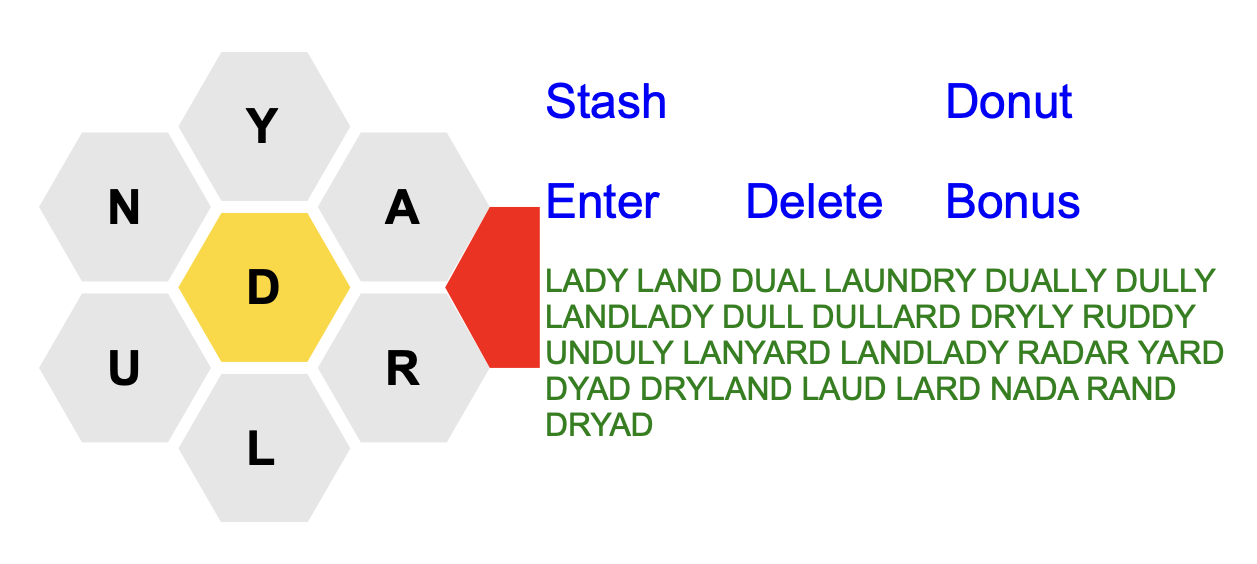
Apologies ... but I couldn’t resist adding 3 more.
The above lengthy humor and satire are great fun, but seriously folks:
Noam Chomsky
The False Promise of ChatGPT
What ChatGPT is Good For
Stephen Fry and Nick Cave
ChatGPT and Human Creativity
Joseph Weizenbaum
Computer Power and Human Reason: From Judgement to Calculation
I asked ChatGPT what Joseph Weizenbaum might think about ChatGPT. It had a balanced and "thoughtful" answer.
Hubert Dreyfus
What Computers Can’t Do
Sam Harris and Cameron Berg
Is AI Already Conscious?